Applied AI / Connected systems / Robotics

Software.
Into the real world.

A shared direction: understand what a home needs, make the next action clear, and explore how machines can help.

Built and tested by Steven Kaplan. Deployed systems first; research and next milestones clearly marked.

Four systems. Start with the operating workflow.

01 / Operational visibility

Deployed

SessionLens

One operating view.
Several sources of truth.

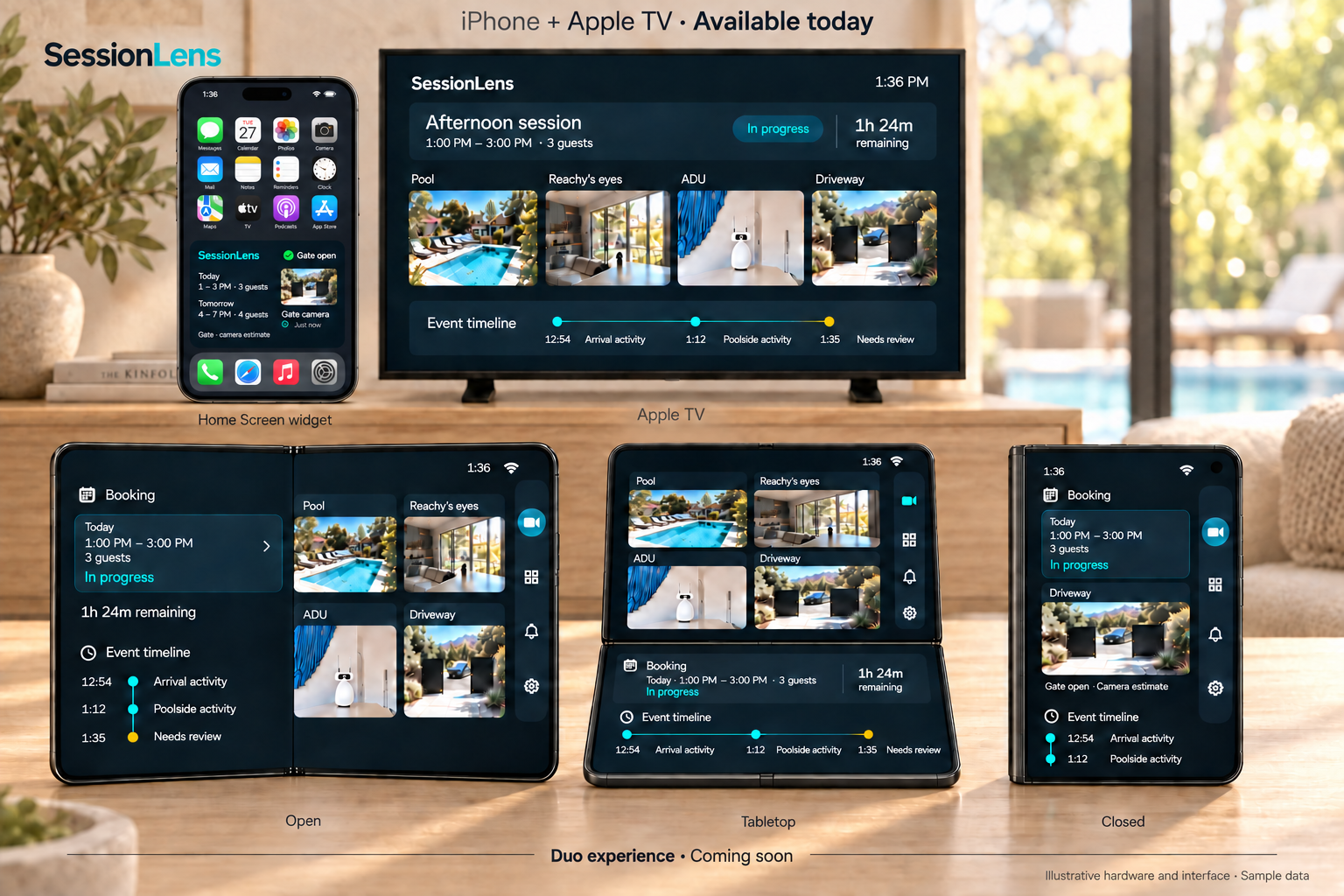
Reservations, camera observations, and connected devices come together in a property dashboard used in daily operations.

The product decision: keep uncertainty visible when combining signals.

  • SwiftUI
  • Home Assistant
  • WebRTC
  • iPhone / iPad / Apple TV
Back to project overview ↑

Devices today · Duo concepts ↑

SessionLens Home Screen widget on iPhone beside Apple TV, with three coming-soon Duo poses
iPhone Home Screen widget + Apple TV today · Duo coming soon · Illustrative hardware & sample data
Reservation contextCamera + device signalsNative review

What works today

Reservation-aware views combine camera feeds, motion events, and gate observations. Native interfaces support review across devices.

System boundary

Observations support human review. They are not proof of intent or a guarantee that a physical event occurred.

Next evaluation

Measure review time, stale or missing inputs, and incorrect inferences. Establish a baseline before claiming an operational improvement.

Decision to exploreWhen is the evidence strong enough to act, and when should the system ask a person?

02 / Contextual automation

Deployed

ClawDomo

From a command
to useful context.

An LLM-powered home assistant combines device state, household routines, and conversation to infer what would be helpful.

The product decision: connect model capability to an everyday operating workflow.

  • Claude
  • Home Assistant
  • Lutron
  • UniFi
  • Sonos
Back to project overview ↑
ClawDomo public microsite describing the connected-home assistant
Project microsite · contextual home automation
Device state + routinesConversational contextConnected-home assistance

What works today

Home Assistant connects lighting, audio, energy, and security. Model updates are integrated into an existing household context.

System boundary

A useful inference is not permission for every action. Action scope, authorization, and recovery need explicit treatment when applying this pattern elsewhere.

Next evaluation

Compare intended and observed device state. Track unwanted actions, human corrections, and behavior when a device is unavailable.

Decision to exploreWhich actions belong in deterministic rules, and which benefit from a model?

03 / Embodied interfaces

Deployed in the lab

Reachy

The interface
enters the room.

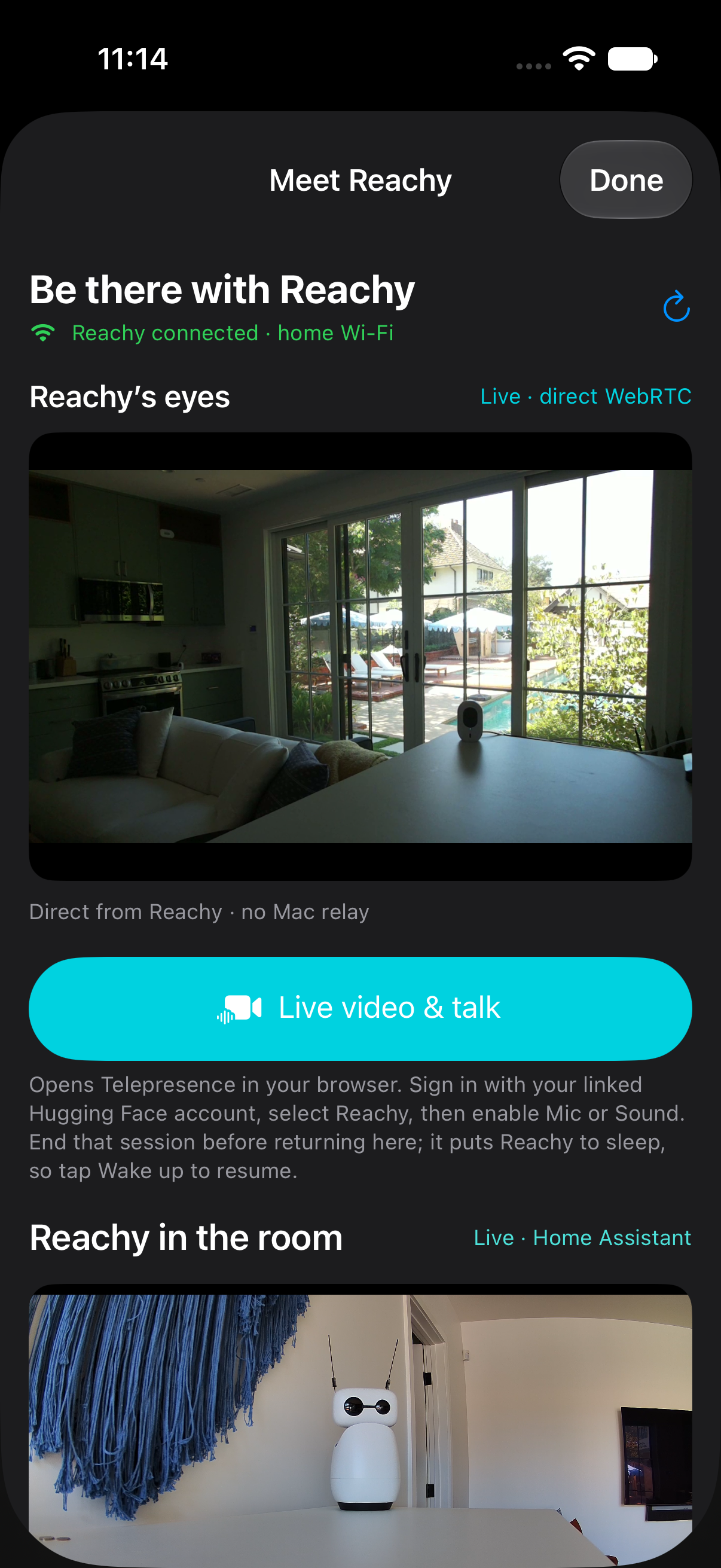
The lab’s first deployed embodied AI connects SessionLens with camera feeds, voice, and expressive movement on Reachy Mini.

The product decision: connect the robot’s view to the context of the session.

  • Reachy Mini
  • Python
  • WebRTC
  • SwiftUI
Back to project overview ↑
Live SessionLens iPhone interface showing Reachy’s camera and room view
Real iPhone capture · camera and room view
Robot camera + voiceSession contextReview + interaction

What works today

Visitor review, robot-camera feeds, and iterative interaction experiments connect a physical robot to SessionLens.

System boundary

Reachy is a lab-scale embodied interface. Deployment here does not establish industrial manipulation, factory reliability, or unsupervised operation.

Next evaluation

Evaluate feed availability, interaction latency, and recovery after connection loss. Separate software behavior from hardware constraints.

Decision to exploreWhat should an operator see when the robot’s picture of the world becomes stale?

04 / Simulation before hardware

Research in progress / Prototype

Robotics Playground

Make the next step
testable.

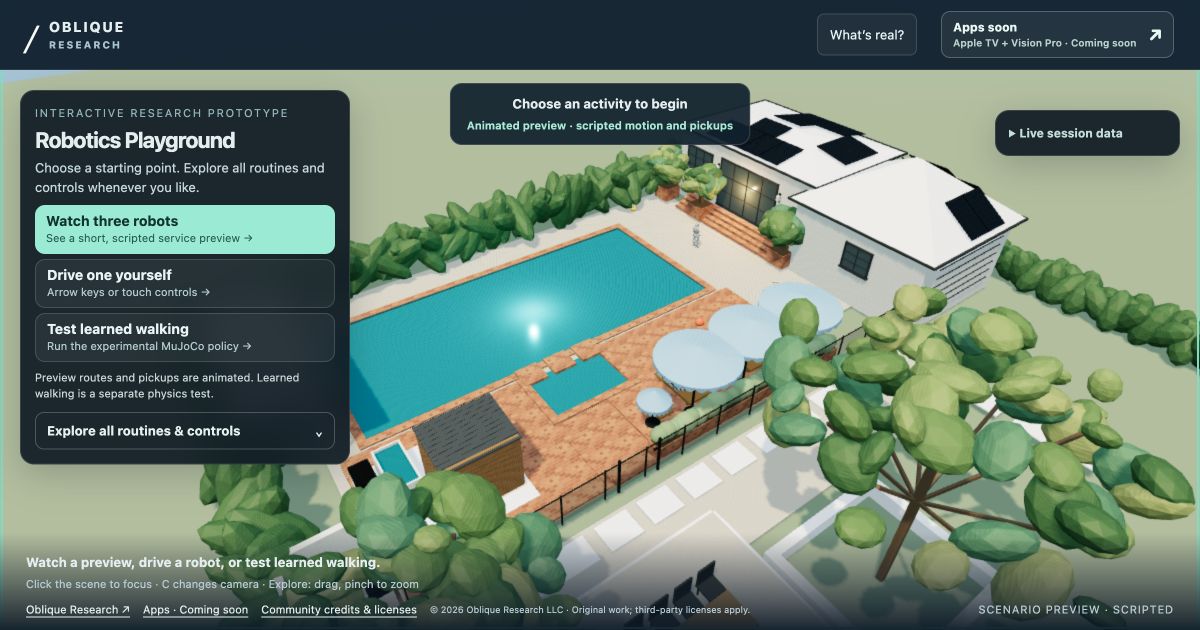
A reconstructed backyard hosts seven service routines and a three-robot scripted preview. Compare authored motion with a community walking policy running in MuJoCo.

The product decision: define the task and evaluation before transferring to hardware.

  • MuJoCo
  • Python
  • Robot SDKs
  • Blender
Explore the prototype ↗
Robotics Playground with a reconstructed backyard and three clear starting activities
Live app capture · three entry points, with scripted and physics modes labeled
Modeled environmentScripted taskHardware evaluation / next

What exists today

Asimov 1 assets, community learned locomotion, MuJoCo dynamics and contacts, and recorded tests provide a concrete environment for iteration.

System boundary

Pickups remain scripted in both modes. Stair climbing and recovery are not trained. This independent Oblique experiment is not an official Menlo product or endorsement.

Next evaluation

On arriving hardware, measure completion, recovery, and human intervention. Test perception and physical constraints separately.

Decision to exploreWhat evidence is required to move from a convincing demonstration to a dependable system?

The common thread

A real workflow.
An observable result.
A better next iteration.

About Steven Kaplan ↗